
Microwave Frequency Fiber Interferometry in Submarine Deployed Telecommunication Cables
A. Bogris et. al. | pre-print: https://arxiv.org/abs/2504.05369 | Article pdf
-
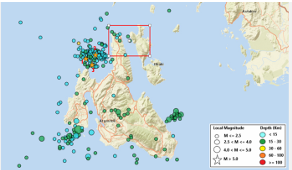
First-ever deployment of MFFI in a submarine environment, successfully operating over a 15.6 km telecom cable between Cephalonia and Ithaca, Greece.
-
Detected over 110 micro-earthquakes with magnitudes as low as 1.5, demonstrating sensitivity comparable to seismic stations and Distributed Acoustic Sensing (DAS) systems.
-
Monitored tidal and ocean surface waves, showing clear correlations between strain data and environmental factors like wind speed and sea conditions.
-
Proved MFFI as a low-cost, robust alternative for high-sensitivity geophysical monitoring in underwater environments, using existing telecom infrastructure.
Sensing with submarine optical cables
A. Mecozzi | APL Photonics, Vol. 9, Issue 7, July 2024 | Article pdf
-
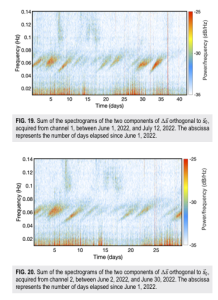
Introduced a theoretical framework for understanding how environmental disturbances (like earthquakes and ocean swells) can be detected using the state of polarization in megameter-long submarine optical cables.
-
Proposed a novel sensing scheme that enables the extraction of environmental perturbations at specific locations along the fiber, using the polarization of backreflected light—making localization of events possible.
-
Demonstrated the advantage of polarization sensing over phase-based methods for detecting very low-frequency signals, as it is less affected by laser phase noise.
-
Validated sensing potential with real-world examples, including earthquake and sea swell detection, using polarization data from a transoceanic fiber-optic link (the Curie cable between Los Angeles and Valparaíso).

Observation of Precursor of the Kamchatka Earthquake by Monitoring an Optical Fiber Link in the Mediterranean Sea
A. Mecozzi, C. Antonelli, D. Decaroli, A. Marullo, L. Palmieri, L. Schenato, S. Varughese, P. Mertz, M. M. Hosseini & A. Napoli | DOI:10.1364/opticaopen.30273163.v1 | Article pdf
- Introduced an ultrasensitive technique for detecting seismic activity and its precursors by monitoring the state of polarisation (SOP) in submarine optical fibre cables, specifically using the Jones matrix extracted from coherent optical communication systems. This approach leverages existing telecommunication infrastructure for environmental sensing without disrupting data traffic or compromising privacy.
- Proposed a method to extract and analyse the 3D rotation vector from the Jones matrix, enabling the detection of environmental perturbations- including those associated with earthquakes-over vast distances. The technique enhances sensitivity to low-frequency signals and allows for the identification of pressure modulations coherent over hundreds of kilometres.
- Demonstrated the method’s effectiveness by observing both the direct seismic signature and a clear precursor of the July 2025 M8.8 Kamchatka earthquake in two Mediterranean Sea fibre links (Catania-Haifa and Catania-Tel Aviv), located approximately 9,000 km from the epicentre. The analysis revealed Rayleigh waves and, notably, resonance features in the SOP data that appe
ared about 20 days before the earthquake and disappeared shortly after, interpreted as a precursor phenomenon. - Validated the approach by correlating SOP anomalies with seismic records and providing a physical inter
pretation: Rayleigh waves generated during earthquake preparation are locally trapped and amplified in the Mediterranean basin, producing resonances detectable by the fibre link. - This finding highlights the potential of SOP-based monitoring for real-time earthquake early warning and precursor detection, offering a scalable and cost-effective solution for global seismic sensing.
Geophysical sensing using Jones matrices extracted from submarine optical cable transceivers carrying live traffic
A. Mecozzi, L. Palmieri, C. Antonelli, L. Schenato, A. Marullo, D. Decaroli, S. Varughese, P. Mertz, & A. Napoli | DOI: doi.org/10.1364/OPTICA.572883 | Article pdf
- Introduced a rigorous theoretical framework for analysing the evolution of polarisation in optical fibres, enabling the extraction of all available information about external environmental perturbations from the Jones matrix retrieved by a coherent receiver during normal operation. This method ensures that data privacy is not compromised and requires no interruption to live telecommunications traffic.
- Proposed a sensing scheme that compares Jones matrices of counter-propagating signals in paired fibres within the same submarine cable. By analysing the perturbation-induced variations of the rotation vectors derived from these matrices, the method is shown to be robust against random polarisation coupling, which can otherwise obscure environmental signals.
- Demonstrated the technique’s effectiveness by applying it to telemetry data from commercial coherent transponders on the MedNautilus undersea fibre-optic system (Catania–Haifa and Catania–Tel Aviv links). The method successfully detected and characterised the seismic signature of the Mw 5.8 Dodecanese Islands earthquake (2 June 2025) using live traffic data,with clear earthquake signatures observed in
the spectrograms of the rotation vectors from both ends of the links. -
Validated the approach by showing that the sensing information encoded in polarisation changes is unaffected by random coupling and is consistent across physically distinct fibres sharing the same cable. The results confirm the feasibility of passive, large-scale seismic monitoring using existing submarine telecommunication infrastructure, opening the door to global geophysical observatories without the need for dedicated sensors.
Phase-sensitive Symmetric Dual-comb Spectroscopy
J. Mateu-Comas, A. Romero-Barrueco, M. Soriano-Amat, S. Martin-Lopez, M. Gonzalez-Herraez, M. R. Fernández-Ruiz| DOI: 10.1109/JLT.2025.3618305 | Article pdf
- Introduced an algorithm capable of extracting both the magnitude and phase spectral information of a sample under test in symmetric dual-comb spectroscopy, a configuration previously thought to only provide magnitude information. The method is generalised for both standard and quasi-integer ratio (QIR) dual-comb schemes, enabling complex-valued spectral characterisation.
- Proposed a phase reconstruction strategy that analyses high-order Nyquist zones in the radio-frequency dom
ain, allowing the recovery of the sample’s spectral phase profile even in symmetric configurations. The algorithm is applicable to any dual-comb spectroscopy system based on a symmetric configuration, regardless of the comb generation technique. - Demonstrated the capability of the approach through experimental validation on two samples: a lossy fibre-based ring resonator (characterised in both overcoupled and undercoupled regimes) and a traceable hydrogen cyanide (HCN) gas cell. The method successfully retrieved both amplitude and phase profiles, with results in excellent agreement with theoretical predictions.
- Validated the technique’s generality and robustness by showing that the phase retrieval algorithm works for both standard (M=1) and QIR (M>1) dual-comb configurations, and by discussing the conditions for validity and accuracy. The approach enables stable, self-referenced, and complete (amplitude and phase) spectral characterisation in dual-comb spectroscopy, opening the door to simpler and more robust implementations.
Earthquake Distance and Magnitude Estimation via Calibrated Microwave Frequency Fiber Interferometry
S. Deligiannidis , Y. Wang, C. Simos , I. Simos , A. Fichtner, N.S. Melis , C. Mesaritakis , A. Bogris| DOI: doi.org/10.48550/arXiv.2507.20551 | Article pdf
- Introduced a calibration framework for a Microwave Frequency Fiber Interferometer (MFFI) designed to estimate both the distance to an earthquake and its magnitude, with the broader aim of enabling early warning capabilities using existing fibre infrastructure.
- Proposed a method that leverages calibrated MFFI sensing to retrieve quantitative seismic parameters from fibre-optic links. The approach involves analysing the strain data captured by the fibre interferometer and applying a calibration process to relate the measur
ed signals to earthquake characteristics. - Demonstrated the technique’s effectiveness through the first experimental validation of calibrated MFFI for quantitative seismic parameter retrieval. The results show that the method can accurately estimate both the distance to the earthquake epicentre and the event’s magnitude, marking a significant advance in distributed fibre-optic sensing for seismology.
- Validated the approach by comparing the MFFI-derived estimates with traditional seismic measurements, confirming the reliability and potential of this method for real-time earthquake monitoring and early warning systems.
Earth-Scale Precursors of the Kamchatka Earthquake Revealed via Polarization Monitoring in Undersea Mediterranean Optical Fiber Links
A. Mecozzi, C. Antonelli, A. Marullo, D. Decaroli, L. Palmieri, L. Schenato, M. M. Hosseini, G. Parisi, A. Napoli & C. Doglioni | DOI: doi.org/10.1364/opticaopen.30763685 | Article pdf
- Introduced a method for detecting earthquake precursors by monitoring the state of polarisation in submarine optical fibre cables carrying live traffic across the Mediterranean Sea. The approach leverages the Jones matrix extracted from coherent optical transponders, enabling highly sensitive detection of environmental perturbations without disrupting data traffic or compromising privacy.
- Proposed an advanced signal processing technique that extracts the three-dimensional rotation vector from the Jones matrix, fully characterising the evolution of polarisation along the fibre. By applying long averaging times and high-contrast spectrogram analysis, the method achieves unprecedented sensitivity to ultra-low-frequency signals, allowing the detection of pressure modulations coherent over hundreds of kilometres.
- Demonstrated the effectiveness of this approach by unambiguously detecting the seismic signature of the July 2025 Mw 8.8 Kamchatka earthquake in multiple Mediterranean fibre links, approximately 9,000 km from the epicentre. Crucially, distinct precursors—resonances and spectral features—were observed up to 20 days before the earthquake, and similar signatures were found for major after
shocks. The analysis revealed that these precursors are likely linked to the excitation of Earth’s normal modes by solid tides, suggesting that earthquake preparation may involve Earth-scale processes. - Validated the method across several independent submarine links (Catania–Haifa, Catania–Tel Aviv, Athens–Chania, Roma–Golfo Aranci, Marseille–Genova), showing consistent detection of both the main event and its precursors. The findings highlight the potential of submarine optical fibre networks as global geophysical observatories, capable of real-time monitoring of seismic activity and providing new insights into earthquake dynamics and early warning systems.
